

Smoked Meat Market Outlook 2026-2036: Global Market to Reach USD 49.04 Billion by 2036 at 1.8% CAGR
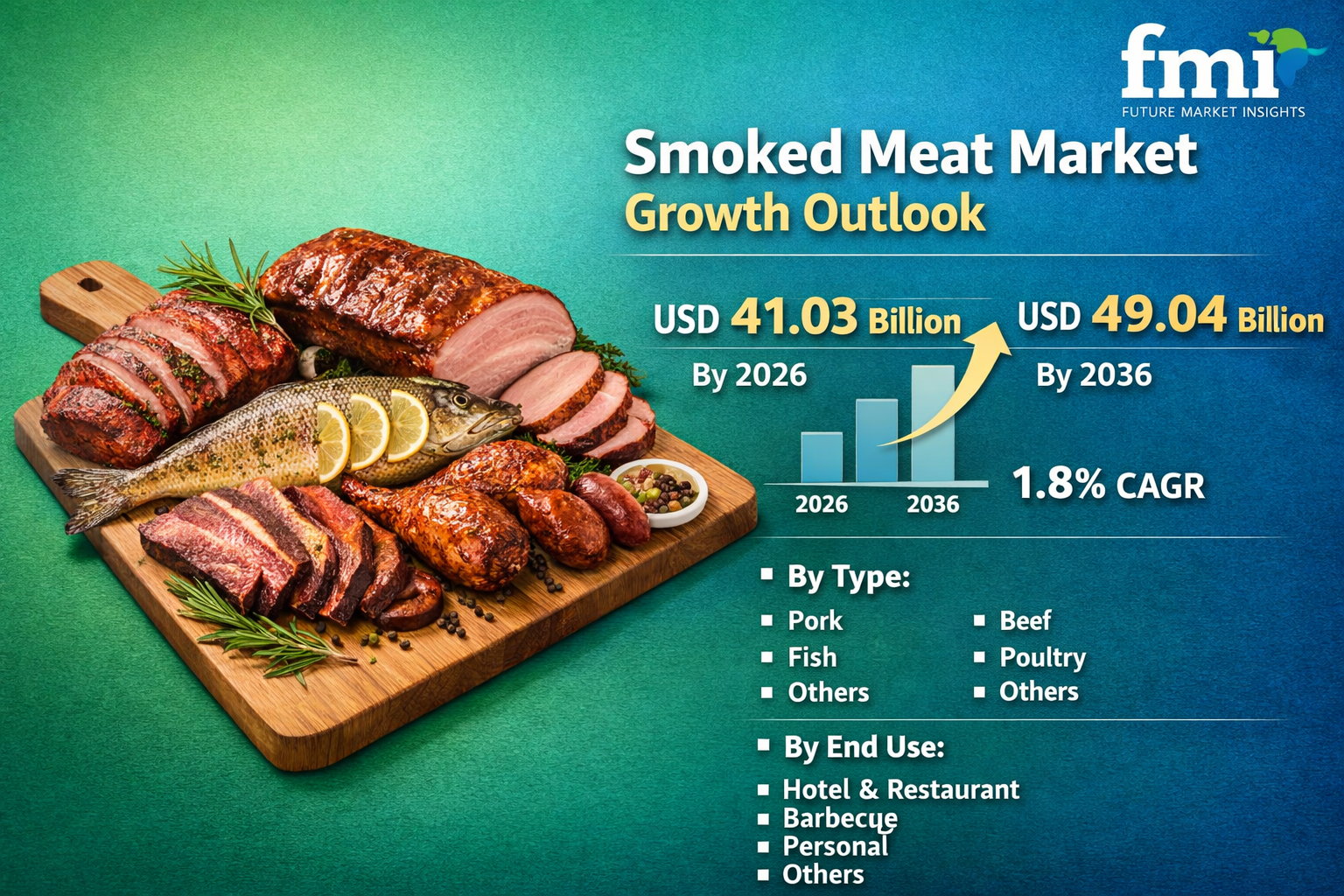
Smoked Meat Industry Size
Global smoked meat market sees steady growth, driven by premiumization, clean-label trends, and strong demand from foodservice and artisanal offerings.
NEWARK, DE, UNITED STATES, March 20, 2026 /EINPresswire.com/ -- According to analysis by Future Market Insights (FMI), the global smoked meat market is entering a phase of measured expansion, where premiumization, regulatory scrutiny, and evolving consumer preferences are redefining value creation across the category. Increasing demand for artisanal flavors, clean-label formulations, and differentiated dining experiences is shaping both product innovation and pricing strategies.
The market was valued at USD 15.02 billion in 2025 and is projected to reach USD 41.03 billion in 2026. Over the forecast period, demand is expected to grow at a CAGR of 1.8%, ultimately reaching USD 49.04 billion by 2036.
This growth trajectory reflects a mature consumption base, particularly in North America and Europe, where per-capita intake has plateaued. Value expansion is being driven primarily through premiumization, including heritage breed sourcing, wood-specific smoking techniques, and clean-label reformulations that command price premiums of 20% to 40% over standard offerings.
To Explore Detailed Market Data, Segment-Wise Forecasts, and Competitive Insights, Request Sample Report. https://www.futuremarketinsights.com/reports/sample/rep-gb-23014
Smoked Meat Market Snapshot
• Market Value (2025): USD 15.02 Billion
• Forecast Value (2036): USD 49.04 Billion
• Forecast CAGR (2026–2036): 1.8%
• Leading Type: Pork (34.7% share)
• Top End Use Segment: Hotel & Restaurant (41.2%)
• Fastest Growing Market: China
Premiumization and Foodservice Demand Drive Market Value
A key force shaping the smoked meat market is the increasing emphasis on premium and artisanal offerings. Foodservice operators, particularly in hotels and restaurants, are leveraging smoked proteins as high-value menu differentiators that support elevated pricing strategies.
Consumers are gravitating toward products featuring:
• Heritage breed meats
• Distinct wood-smoke profiles (e.g., applewood, cherrywood)
• Authentic, traditional smoking techniques
This shift is transforming smoked meat from a conventional processed category into a premium culinary experience, especially within hospitality and fine dining channels.
Regulatory Pressures and Reformulation Challenges
The smoked meat market faces structural challenges due to tightening global regulations around processed meat consumption. The classification by World Health Organization of processed meats as Group 1 carcinogens continues to influence consumer perception and policy frameworks.
In key regions such as Europe, front-of-pack labeling systems penalize processed meat products, impacting retail visibility and demand.
Manufacturers are responding through:
• Reduced-nitrite and nitrate-free formulations
• Adoption of natural curing agents such as celery powder
• Transition toward traditional smoking processes
However, these changes increase production costs by 8% to 12%, creating margin pressures across the value chain.
Mature Markets Limit Volume Growth
Unlike emerging protein categories, smoked meat operates within a largely saturated consumption environment in Western markets. Growth in these regions is constrained by:
• Stable or declining per-capita consumption
• Health-driven dietary shifts
• Regulatory and labeling constraints
As a result, incremental revenue opportunities remain modest in absolute terms, with expansion dependent on value-added innovation rather than volume growth.
Asia Emerges as a Strategic Growth Frontier
Regionally, growth trajectories vary significantly, with Asia showing relatively stronger momentum.
Smoked Meat Market Growth by Country (2026–2036):
• China: 2.4%
• India: 2.3%
• Germany: 2.1%
• France: 1.9%
• United Kingdom: 1.7%
• United States: 1.5%
• Brazil: 1.4%
China leads global growth, driven by expanding consumption of ready-to-eat protein products and commercialization of traditional smoked meats such as la rou and smoked duck. India follows closely, supported by rising urbanization, increasing processed meat acceptance, and the growth of online meat delivery platforms.
Clean Label and Flavor Innovation Unlock Opportunities
Innovation remains central to sustaining growth in the smoked meat market. Manufacturers are investing in:
• Clean-label curing processes
• Advanced smoking technologies
• Flavor innovation using herbs, spices, and specialty woods
• Convenience-driven packaging formats such as vacuum-sealed and ready-to-eat portions
These advancements are helping brands differentiate in a competitive and regulated environment while catering to evolving consumer preferences for transparency and quality.
Segment Insights Strengthen Market Structure
By type, pork continues to dominate the smoked meat category, accounting for 34.7% of market share. Its versatility, affordability, and widespread culinary acceptance support its leadership across both retail and foodservice channels.
By end use, the hotel and restaurant segment remains the primary demand driver, contributing 41.2% of market share in 2026. The hospitality sector’s focus on premium dining experiences and menu differentiation continues to elevate the role of smoked proteins.
Competitive Landscape
The smoked meat market is moderately consolidated, with leading players focusing on product innovation, premium branding, and operational efficiency. Key companies include:
• WH Group
• Hormel Foods Corporation
• Yunrun Group
• Fratelli Beretta
• Columbus Foods
• Kayem Foods
These companies are investing in clean-label product lines, sustainable sourcing, automated processing facilities, and cold-chain logistics to strengthen their market position.
Market Outlook: Value Growth Over Volume Expansion
The long-term outlook for the smoked meat market remains stable but constrained, defined by limited volume growth and increasing regulatory scrutiny.
Future expansion will depend on:
• Premiumization through artisanal and heritage-based offerings
• Commercialization of traditional smoked meats in emerging markets
• Innovation in clean-label and health-oriented formulations
As consumer preferences evolve and regulatory frameworks tighten, smoked meat is transitioning into a value-driven category, where differentiation, authenticity, and quality will determine competitive success in the global protein landscape.
Browse More Reports From Food and Beverages:
Seed Coating Material Market: https://www.futuremarketinsights.com/reports/seed-coating-material-market
Probiotic Supplements Market: https://www.futuremarketinsights.com/reports/probiotic-supplements-for-kids-market
Upcycled Food Products Market: https://www.futuremarketinsights.com/reports/upcycled-food-products-market
Mushroom Market: https://www.futuremarketinsights.com/reports/mushroom-market
Sudip Saha
Future Market Insights Inc.
+ +1 347-918-3531
email us here
Legal Disclaimer:
EIN Presswire provides this news content "as is" without warranty of any kind. We do not accept any responsibility or liability for the accuracy, content, images, videos, licenses, completeness, legality, or reliability of the information contained in this article. If you have any complaints or copyright issues related to this article, kindly contact the author above.
