

Snail Market Forecast 2026-2036: Global Market to Reach USD 1723.1 Million by 2036 at 8.5% CAGR
Snail Industry Analysis
Global snail market growth is driven by heliciculture expansion, premium escargot demand, and rising use in food, cosmetics, and pharma industries.
NEWARK, DE, UNITED STATES, March 20, 2026 /EINPresswire.com/ -- According to analysis by Future Market Insights (FMI), the global snail market is entering a phase of accelerated structural expansion as heliciculture scaling, premium gastronomy demand, and value-added processing redefine both supply economics and pricing power. Increasing consumer interest in exotic, protein-rich foods and the growing adoption of processed escargot formats are reshaping production strategies and value realization across the industry.
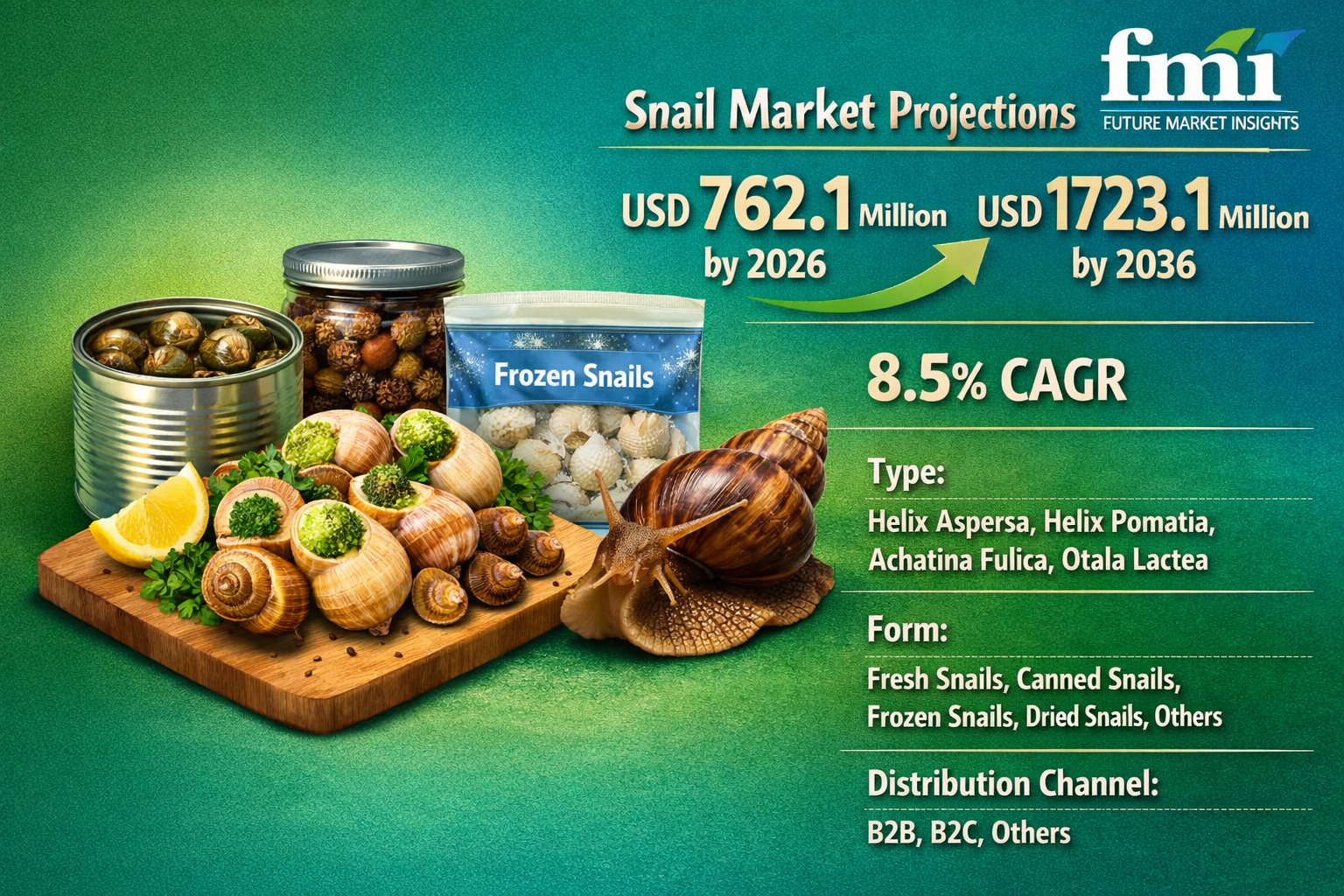
The market was valued at USD 265.1 million in 2025 and is projected to reach USD 762.1 million in 2026. Over the forecast period, demand is expected to grow at a CAGR of 8.5%, ultimately reaching USD 1,723.1 million by 2036. This strong growth trajectory reflects a combination of rising production volumes through organized heliciculture and increasing per-unit value driven by processed snail products such as canned, frozen, and ready-to-cook escargot.
Get Access of Report Sample: https://www.futuremarketinsights.com/reports/sample/rep-gb-25957
Snail Market Snapshot
• Market Value (2025): USD 265.1 Million
• Forecast Value (2036): USD 1,723.1 Million
• Forecast CAGR (2026–2036): 8.5%
• Leading Type: Helix Aspersa (34%+ share)
• Top Distribution Channel: B2B (47%+ share)
• Fastest Growing Market: China
Premiumization and Processed Escargot Driving Demand
A defining trend in the snail market is the shift from raw commodity sales to value-added processed products. Escargot, particularly in canned, frozen, and pre-seasoned formats, is increasingly preferred by restaurants and foodservice buyers due to convenience, consistency, and higher culinary value.
Snails are evolving from niche ingredients into premium gastronomic offerings, particularly across European cuisines. The growing popularity of gourmet dining and specialty protein consumption is further elevating their positioning as a delicacy product.
At the same time, fresh (live) snails remain essential for traditional culinary applications, especially in high-end restaurants where authenticity and preparation control are critical.
Cultural Consumption Patterns Shape Global Demand
The snail market is structurally influenced by strong regional consumption patterns. Mediterranean Europe—particularly France, Spain, Italy, Greece, and Portugal—continues to dominate demand, while West African markets such as Nigeria and Ghana represent significant consumption hubs.
France alone consumes an estimated 30,000 to 40,000 tonnes annually, relying heavily on imports from Eastern Europe, Turkey, and North Africa. This persistent supply-demand imbalance is encouraging domestic heliciculture expansion and international trade flows.
Meanwhile, East Asia is emerging as a high-growth region, with China positioning snails as a delicacy protein across both foodservice and processed retail formats.
Heliciculture Expansion and Regulatory Dynamics Shape Supply
Supply-side dynamics are increasingly defined by the transition from wild harvesting to structured heliciculture systems. Regulatory pressure, traceability requirements, and habitat constraints are reducing reliance on wild snail populations.
Modern farming systems in countries such as Italy, Spain, and Poland are adopting standardized open-field and greenhouse models, delivering yields of 8 to 12 tonnes per hectare annually. These systems improve consistency, biosecurity, and scalability.
Additionally, compliance frameworks such as EU traceability regulations are pushing producers to implement full farm-to-fork documentation, enhancing product quality, safety, and export competitiveness.
Helix Aspersa Leads Product Demand
By type, Helix Aspersa dominates the global snail market with over 34% share. Its leadership is supported by:
• Rapid growth cycle and high reproduction rate
• Adaptability to controlled farming environments
• Strong demand in gourmet cuisines
This species remains the preferred choice for commercial farming due to its efficiency and suitability across fresh and processed formats.
B2B Channel Dominates Market Distribution
By distribution channel, B2B accounts for more than 47% of the market in 2026, driven by:
• Strong demand from restaurants and foodservice operators
• Bulk procurement by processors and exporters
• Consistent supply requirements for gourmet dining
Unlike many food categories, snail consumption remains heavily concentrated in institutional and foodservice channels rather than direct retail, although e-commerce and specialty retail are gradually expanding access.
Global Growth Momentum Led by Asia and Europe
The snail market is witnessing robust growth across both emerging and mature economies:
• China: 11.5%
• India: 10.6%
• Germany: 9.8%
• France: 8.9%
• United Kingdom: 8.1%
• United States: 7.2%
• Brazil: 6.4%
China leads global expansion due to strong consumption growth and scaling production, while India follows with increasing heliciculture adoption and rising cosmetic applications. Mature markets such as the United States and Brazil are expected to grow steadily, supported by premiumization and niche culinary demand.
Traceability, Skincare Applications, and Innovation Unlock Opportunities
Beyond food applications, the snail market is expanding into high-value sectors such as cosmetics and pharmaceuticals. Snail mucin, known for its regenerative and hydrating properties, is widely used in skincare formulations, creating a parallel premium revenue stream.
At the same time, innovations in:
• Farming automation and controlled breeding
• Cold-chain logistics and processing
• Packaging and shelf-life extension
are improving supply reliability and global distribution efficiency.
Emerging pharmaceutical research into bioactive compounds derived from snails is also opening new avenues for therapeutic applications, further broadening market potential.
Competitive Landscape
Leading companies in the snail market include:
• Bourgogne Escargots
• Romanzini
• ESCAL S.A.
• Bages Cargol S.L.
• Aspersa Snails International
• LUMACA Italia
• Gaelic Escargot
• Peconic Escargot
• SABAROT WASSNER
• UAB Gardumeli
These players are focusing on integrated farming, processing capabilities, traceability compliance, and premium product positioning to strengthen their global footprint.
Market Outlook: From Niche Delicacy to Scalable Premium Industry
The long-term outlook for the snail market remains highly positive, supported by rising global demand for alternative proteins, premium culinary experiences, and multifunctional ingredients across food and cosmetics.
However, the industry will continue to be shaped by production constraints, regulatory compliance, and the need for standardized farming practices.
As heliciculture scales and processed snail products gain wider acceptance, the market is transitioning from a niche specialty segment into a structured, high-value global industry with diversified revenue streams and strong growth potential.
Browse More Reports From Food and Beverages:
Confectionery Market: https://www.futuremarketinsights.com/reports/asean-confectionery-market
Beta Carotene Market: https://www.futuremarketinsights.com/reports/beta-carotene-market
Fertility Supplement Market: https://www.futuremarketinsights.com/reports/fertility-supplements-market
Hydrolyzed Vegetable Protein Market: https://www.futuremarketinsights.com/reports/hydrolysed-vegetable-protein-market
Sudip Saha
Future Market Insights Inc.
+ +1 347-918-3531
email us here
Legal Disclaimer:
EIN Presswire provides this news content "as is" without warranty of any kind. We do not accept any responsibility or liability for the accuracy, content, images, videos, licenses, completeness, legality, or reliability of the information contained in this article. If you have any complaints or copyright issues related to this article, kindly contact the author above.
