

Folding IBC Market to Reach USD 5.2 Billion by 2035 Driven by Asia Pacific Growth and Schoeller Allibert Leadership
Folding IBC Market
Revenue from folding IBCs in Japan is set to grow at a 9.8% CAGR by 2035, driven by advanced manufacturing and demand for efficient returnable packaging.
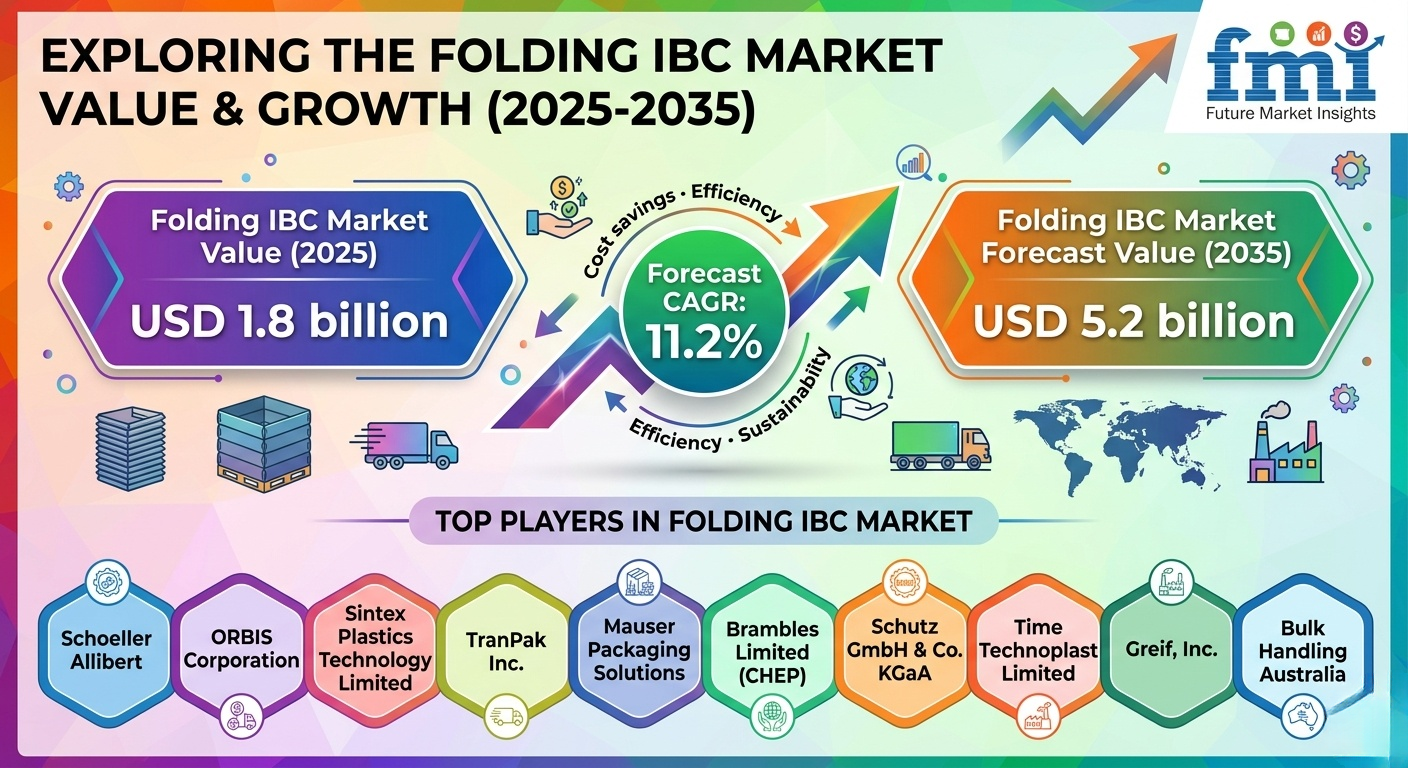
NEWARK, DE, UNITED STATES, March 30, 2026 /EINPresswire.com/ -- The global folding Intermediate Bulk Container (IBC) market is entering a high-growth phase as industries increasingly shift toward returnable packaging, space-efficient storage, and logistics cost optimization. The folding IBC market is projected to grow from USD 1.8 billion in 2025 to USD 5.2 billion by 2035, registering a CAGR of 11.2%, driven by rising global trade, chemical transportation demand, and warehouse efficiency requirements.
Folding IBCs are becoming a strategic logistics asset rather than just bulk storage containers, particularly in industries handling bulk liquids, chemicals, food ingredients, pharmaceuticals, and industrial materials. Their collapsible design significantly reduces reverse logistics costs and storage space requirements, making them highly attractive for modern supply chain operations.
Logistics Optimization and Returnable Packaging Driving Market Growth
One of the primary growth drivers for the folding IBC market is the global shift toward returnable and reusable bulk packaging systems. Companies across industries are focusing on reducing packaging waste, improving transportation efficiency, and lowering total logistics costs.
Discover Growth Opportunities in the Market – Get Your Sample Report Now
https://www.futuremarketinsights.com/reports/sample/rep-gb-4476
Key growth drivers include:
• Rising demand for returnable bulk packaging solutions
• Increasing focus on transportation cost reduction
• Expansion of chemical manufacturing and bulk liquid transportation
• Growth in e-commerce distribution centers and warehouses
• Adoption of circular economy and reusable packaging systems
• Need for space-efficient storage and reverse logistics optimization
Folding IBCs can reduce empty container storage space by up to 70%, making them ideal for global logistics networks where return shipping and warehouse space are major cost factors.
Emerging Trends Transforming the Folding IBC Industry
Technological innovation and material engineering are transforming folding IBC design and expanding their application areas. Manufacturers are introducing new polymer materials, improved folding mechanisms, and specialized containers for temperature-sensitive or hazardous materials.
Key market trends include:
• Lightweight high-strength polymer folding IBCs
• UV-resistant and chemical-resistant container materials
• Integration with automated filling and logistics systems
• Smart tracking and RFID-enabled containers
• Hygienic folding IBCs for food and pharmaceutical industries
• Temperature-controlled folding IBC systems
These innovations are expanding folding IBC applications beyond chemicals into food ingredients, edible oils, beverages, pharmaceutical raw materials, and specialty industrial liquids.
Asia Pacific Leads Market Growth While Europe and North America Focus on Efficiency
Regionally, Asia Pacific is expected to be the fastest-growing folding IBC market, driven by rapid industrialization, chemical manufacturing expansion, and logistics infrastructure development in China and India.
Country growth outlook (2025–2035 CAGR):
• China – 12.7%
• Germany – 10.8%
• USA – 10.5%
• UK – 10.2%
• Japan – 9.8%
North America and Europe remain mature but highly important markets, where demand is driven by logistics efficiency, returnable packaging adoption, and regulatory compliance for chemical transportation.
Europe alone is projected to grow from USD 0.6 billion in 2025 to USD 1.7 billion by 2035, supported by strong chemical manufacturing and industrial logistics infrastructure.
Chemicals Industry Remains the Largest End-Use Segment
The chemicals industry accounts for approximately 39% of folding IBC market demand, as folding containers are widely used for transporting chemicals, solvents, lubricants, and hazardous materials safely and efficiently.
Industry contribution to folding IBC demand:
• Logistics & Supply Chain: 35–40%
• Chemicals: 20–25%
• Food & Beverage: 18–20%
• Pharmaceuticals: 12–15%
• Automotive & Manufacturing: 8–10%
Rigid folding IBCs dominate the market with 58% market share, due to their structural strength, load-bearing capacity, and long lifecycle performance in industrial logistics.
Competitive Landscape and Market Leaders
The folding IBC market is moderately consolidated, with the top three companies accounting for approximately 45–52% of global market share. Competition is primarily based on container durability, collapsibility, cost efficiency, and regulatory compliance rather than price alone.
Key companies operating in the folding IBC market include:
Schoeller Allibert, ORBIS Corporation, Sintex Plastics Technology Limited, TranPak Inc., Mauser Packaging Solutions, Brambles Limited (CHEP), Schutz GmbH & Co. KGaA, Time Technoplast Limited, Greif, Inc., Bulk Handling Australia
Market leaders are focusing on lightweight materials, improved folding mechanisms, and customized folding IBC solutions for chemical, food, and pharmaceutical industries.
Analyst Insight: Folding IBCs Becoming Core Infrastructure in Modern Logistics
Industry analysts indicate that folding IBCs are transitioning from optional bulk containers to core infrastructure in global logistics and industrial packaging systems. As transportation costs rise and warehouse space becomes more expensive, collapsible bulk containers offer measurable economic advantages across supply chains.
Returnable packaging programs, circular economy initiatives, and sustainability goals are expected to further accelerate folding IBC adoption across industries over the next decade.
Future Outlook: Strong Opportunities Across Chemicals, Food, Pharma, and Logistics
The folding IBC market is expected to see strong growth opportunities in:
• Chemical bulk transportation
• Food ingredient and edible oil logistics
• Pharmaceutical raw material handling
• E-commerce warehouse distribution
• Industrial lubricant and oil transportation
• Automotive and manufacturing supply chains
• Circular economy and reusable packaging programs
As global trade volumes increase and supply chains become more efficiency-focused, folding IBCs are expected to become one of the most important bulk logistics packaging solutions worldwide.
Why FMI: https://www.futuremarketinsights.com/why-fmi
Explore More Research Reports by FMI
Demand for Heavy Duty Bag and Sack in the UK - https://www.futuremarketinsights.com/reports/united-kingdom-heavy-duty-bag-and-sack-market
Foil Labels Market - https://www.futuremarketinsights.com/reports/foil-labels-market
Plastic Jar Packaging Market - https://www.futuremarketinsights.com/reports/plastic-jar-packaging-market
IV Bag Market - https://www.futuremarketinsights.com/reports/iv-bag-market
Nutraceutical Packaging Market - https://www.futuremarketinsights.com/reports/nutraceutical-packaging-market
About Future Market Insights (FMI)
Future Market Insights, Inc. (FMI) is an ESOMAR-certified, ISO 9001:2015 market research and consulting organization, trusted by Fortune 500 clients and global enterprises. With operations in the U.S., UK, India, and Dubai, FMI provides data-backed insights and strategic intelligence across 30+ industries and 1200 markets worldwide.
Sudip Saha
Future Market Insights Inc.
+1 347-918-3531
email us here
Legal Disclaimer:
EIN Presswire provides this news content "as is" without warranty of any kind. We do not accept any responsibility or liability for the accuracy, content, images, videos, licenses, completeness, legality, or reliability of the information contained in this article. If you have any complaints or copyright issues related to this article, kindly contact the author above.
