

Emulsion Stabilizers Market Outlook: Price Trends, Production Capacity and Demand Forecast (2026–2036)
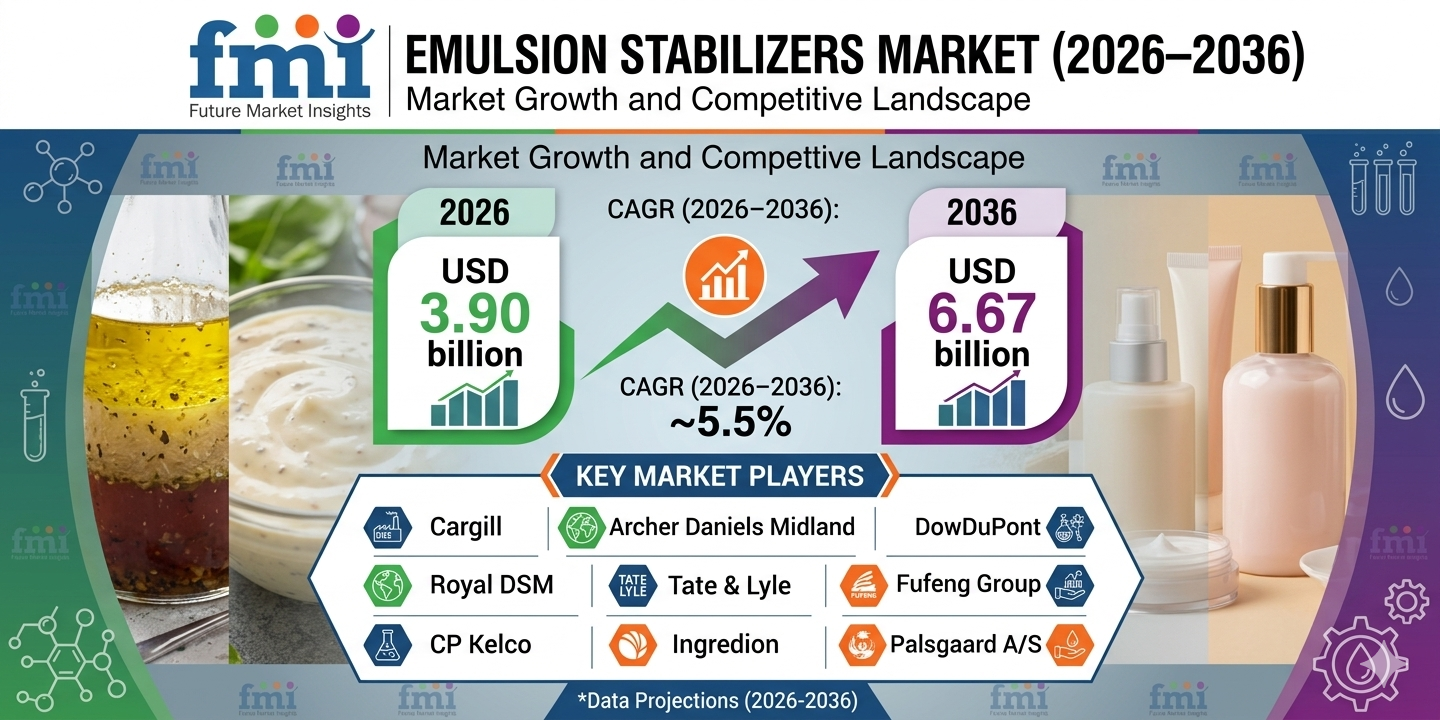
Rising demand for multi-functional stabilizer systems across food, textile, pharmaceutical, and personal care industries drives sustained global growth
NEWARK, DE, UNITED STATES, April 3, 2026 /EINPresswire.com/ -- The global Emulsion Stabilizers Market is valued at USD 3.90 billion in 2026 and is projected to reach USD 6.67 billion by 2036, expanding at a CAGR of 5.5% from 2026 to 2036. Growth is being driven by the increasing adoption of hydrocolloid and phosphate-based stabilizer systems across diverse industrial applications, alongside rising clean label requirements and performance optimization needs across formulation-driven industries.
As industries increasingly rely on stable emulsions for product consistency, shelf life, and processing efficiency, emulsion stabilizers are evolving from basic functional additives into multi-specification ingredients tailored for cross-industry use.
Emulsion Stabilizers Market Snapshot (2026–2036)
• Market size in 2026: USD 3.90 billion
• Market size in 2036: USD 6.67 billion
• CAGR (2026–2036): ~5.5%
• Leading form: Powder stabilizers
• Top end-use segment: Textile industry
• Key material types: Hydrocolloids and phosphates
• Fastest-growing country: China
• Key companies: Global ingredient and specialty chemical manufacturers
Market Momentum
The market is valued at USD 3.70 billion in 2025 and demonstrates steady expansion as demand diversifies across industries. Between 2026 and 2030, clean label reformulation in food and beverage applications, combined with scaling textile production, accelerates stabilizer consumption.
From 2030 onward, increased regulatory scrutiny, sustainability targets, and advancements in formulation science further reinforce demand. By 2036, the market reaches USD 6.67 billion, supported by the integration of stabilizers into high-performance and compliance-driven production systems.
Request For Sample Report | Customize Report |purchase Full Report - https://www.futuremarketinsights.com/reports/sample/rep-gb-7944
Why the Market is Growing
The Emulsion Stabilizers Market is expanding as industries require reliable solutions to maintain uniform dispersion, prevent phase separation, and control viscosity in complex formulations. In food processing, clean label mandates are pushing manufacturers toward natural stabilizers such as xanthan gum and pectin.
In textile manufacturing, stabilizers play a critical role in sizing, coating, and finishing processes, ensuring uniform application and improved fabric performance. Meanwhile, pharmaceutical and personal care industries depend on stabilizers for consistency, shelf stability, and product efficacy.
Additionally, the need to balance sustainability with performance is driving innovation in biodegradable and low-toxicity stabilizer systems. Manufacturers are increasingly adopting dual-purpose stabilizers capable of meeting multiple application requirements from a single formulation platform.
Segment Spotlight
1. End Use: Textile Industry Leads Demand
The textile sector accounts for approximately 46.8% of total demand, driven by extensive use in fabric finishing processes requiring stable emulsions for coating, printing, and sizing applications.
2. Form: Powder Stabilizers Dominate
Powder-based stabilizers hold nearly 49.6% market share in 2026, favored for their superior shelf stability, ease of transportation, and precise dosing in automated production systems.
3. Type: Hydrocolloids Remain Core Materials
Hydrocolloids such as xanthan gum, pectin, and carboxymethyl cellulose continue to dominate due to their versatility, natural origin, and compatibility with clean label requirements.
Drivers, Opportunities, Trends, Challenges
• Drivers: Clean label mandates, expansion of textile manufacturing, rising demand for stable emulsions
• Opportunities: Multi-functional stabilizer systems, sustainable formulations, emerging market expansion
• Trends: Shift toward natural hydrocolloids, formulation-driven procurement, regulatory compliance focus
• Challenges: Raw material variability, reformulation costs, stringent validation requirements
Country Growth Outlook (2026–2036)
China leads the market with a projected CAGR of 7.4%, driven by strong textile manufacturing and processed food production capacity. India follows at 6.9%, supported by growing packaged food demand and textile exports.
Germany and France exhibit steady growth due to clean label reformulation trends in the food industry, while the United Kingdom and the United States maintain consistent expansion driven by mature markets and incremental innovation. Brazil shows moderate growth supported by beverage and textile sector investments.
Competitive Landscape
The market is characterized by global ingredient suppliers and specialty chemical companies competing on product quality, sourcing reliability, and technical support capabilities. Companies are increasingly focusing on expanding their clean label portfolios, improving hydrocolloid sourcing, and offering application-specific solutions.
Competition is shifting toward integrated service offerings, where suppliers provide not only stabilizers but also formulation support, regulatory compliance documentation, and performance validation across multiple end-use industries.
Frequently Asked Questions (FAQ)
What is the global Emulsion Stabilizers Market size?
The market is valued at approximately USD 3.90 billion in 2026 and is projected to reach USD 6.67 billion by 2036.
At what rate is the market expected to grow?
The market is forecast to expand at a CAGR of about 5.5% from 2026 to 2036.
What are emulsion stabilizers?
They are functional ingredients, primarily hydrocolloids and phosphates, that prevent phase separation, control viscosity, and maintain uniform dispersion in emulsion systems.
Why are emulsion stabilizers gaining importance?
They enhance product stability, improve shelf life, support clean label initiatives, and enable consistent performance across food, textile, pharmaceutical, and personal care applications.
Explore More Related Studies Published by FMI Research:
Aircraft Contaminant-Resistant Coatings Market https://www.futuremarketinsights.com/reports/aircraft-contaminant-resistant-coatings-market
Precipitated Silica Market https://www.futuremarketinsights.com/reports/precipitated-silica-market
Lithium and Lithium Ion Battery Electrolyte Market https://www.futuremarketinsights.com/reports/lithium-and-lithium-ion-battery-electrolytes-market
About Future Market Insights (FMI)
Fture Market Insights, Inc. (FMI) is an ESOMAR-certified, ISO 9001:2015 market research and consulting organization, trusted by Fortune 500 clients and global enterprises. With operations in the U.S., UK, India, and Dubai, FMI provides data-backed insights and strategic intelligence across 30+ industries and 1200 markets worldwide.
Why Choose FMI: https://www.futuremarketinsights.com/why-fmi
Sudip Saha
Future Market Insights Inc.
+1 347-918-3531
rahul.singh@futuremarketinsights.com
Legal Disclaimer:
EIN Presswire provides this news content "as is" without warranty of any kind. We do not accept any responsibility or liability for the accuracy, content, images, videos, licenses, completeness, legality, or reliability of the information contained in this article. If you have any complaints or copyright issues related to this article, kindly contact the author above.
